| --- |
| license: mit |
| datasets: |
| - ammarnasr/the-stack-java-clean |
| library_name: adapter-transformers |
| tags: |
| - code |
| pipeline_tag: text-generation |
| language: |
| - code |
| --- |
| |
|
|
| # CodeGen (CodeGen-Mono 350M LoRa Java) |
|
|
| ## Model description |
| CodeGen LoRa Java is a family of autoregressive language models fine-tuned using LoRa on Different Programming Langauges. |
| ## Training data |
| <!-- https://huggingface.co/datasets/ammarnasr/the-stack-java-clean --> |
| This model was fine-tuned on the cleaned Java subset from TheStack Avilable [here](https://huggingface.co/datasets/ammarnasr/the-stack-java-clean). The data consists of 1 Million Java code files. |
|
|
| ## Training procedure |
|
|
| This model was fine-tuned using LoRa on 1 T4 GPU. The model was trained for 10,000 steps with batch size of 4. The model was trained using causal language modeling loss. |
|
|
| ## Evaluation results |
|
|
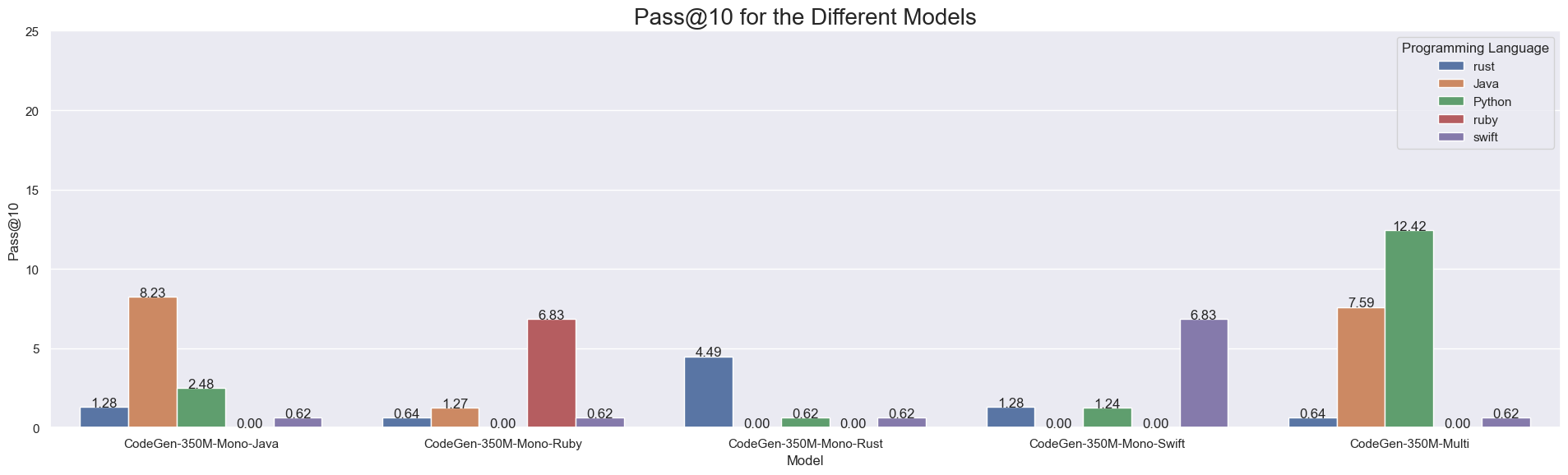
| We evaluate our models on the MultiPle-E bencchmark. The model achieves 8.9 Pass@10 Rate. |
|  |
|
|
|
|
| ## Intended Use and Limitations |
|
|
| However, the model is intended for and best at **program synthesis**, that is, generating executable code given English prompts, where the prompts should be in the form of a comment string. The model can complete partially-generated code in Java and Python. |
|
|
| ## How to use |
|
|
| This model can be easily loaded using the `AutoModelForCausalLM` functionality: |
|
|
| ```python |
| from transformers import AutoTokenizer, AutoModelForCausalLM |
| from peft import PeftConfig, PeftModel |
| |
| model_name = "ammarnasr/codegen-350M-mono-java" |
| peft_config = PeftConfig.from_pretrained(model_name) |
| |
| tokenizer = AutoTokenizer.from_pretrained(peft_config.base_model_name_or_path) |
| |
| model = AutoModelForCausalLM.from_pretrained(peft_config.base_model_name_or_path) |
| model = PeftModel.from_pretrained(model, model_name) |
| |
| model.print_trainable_parameters() |
| |
| text = "public static void main(String[] args) {" |
| input_ids = tokenizer.encode(text, return_tensors="pt") |
| generated_ids = model.generate(input_ids=input_ids, max_length=100) |
| print('Generated: \n') |
| print(tokenizer.decode(generated_ids[0], skip_special_tokens=True)) |
| ``` |
|
|
| ## BibTeX entry and citation info |
|
|
| ```bibtex |
| @article{Nijkamp2022ACP, |
| title={A Conversational Paradigm for Program Synthesis}, |
| author={Nijkamp, Erik and Pang, Bo and Hayashi, Hiroaki and Tu, Lifu and Wang, Huan and Zhou, Yingbo and Savarese, Silvio and Xiong, Caiming}, |
| journal={arXiv preprint}, |
| year={2022} |
| } |
| ``` |

